
Hopeful Signs for the Road Ahead
Published on 30th Jun, 2026
Recently, there has been encouraging news about the Cathedral of the Holy Spirit. We have been advised that work to reorganise, refurbish, or reorder the interior would not trigger a resource consent — a significant development, since that process may have required costly strengthening work. This gives us the freedom to begin thinking carefully and creatively about the cathedral’s future.
At present, the cathedral’s capacity is less than optimal. On many Sundays, we cannot comfortably accommodate everyone, and for major diocesan occasions — Holy Thursday, Good Friday, First Holy Communions, Confirmations, major funerals and ordinations — the building is no longer adequate for our needs.
Any reordering of the cathedral will need to be undertaken with care. We want to preserve its beauty and honour the theological vision already present in the building, while also listening to the wisdom, experience and deep affection of the local community. In due course, any proposed plans will be shared with our people for feedback.
There is also good news in the area of vocations. We now have a strong number of seminarians in formation, another potential seminarian has recently joined the community, and several priests have expressed a desire to come and serve in this diocese. Some are due to arrive soon. This is a lovely change for us, and it gives us greater flexibility as we look to the future.
Rather than simply asking where we may need to withdraw, I find myself wondering how we might reinvigorate parts of the diocese with new priests and perhaps with religious communities. There are already encouraging possibilities in this area. They are useful signs of life among us, and part of a wider renewal in Catholic culture that seems to be emerging around the world and, I think, here too.
The question of liturgical posture remains an ongoing process. I have received many submissions, revealing a real diversity of opinion, and I do not want to rush the discernment. I want to listen carefully, be prayerful, and take the time needed to consider the matter well. I remain committed to reaching an answer in the coming months.
Alongside that, we are continuing our examination of key elements of the liturgical document of the Second Vatican Council. What I have appreciated is the way this process has moved beyond simply reading words on a page. Each engagement has involved prayer, discussion and discernment among priests, lay faithful and religious from across the diocese. It is a real engagement with the text, rather than a simple rules-based exercise, and I think that matters.
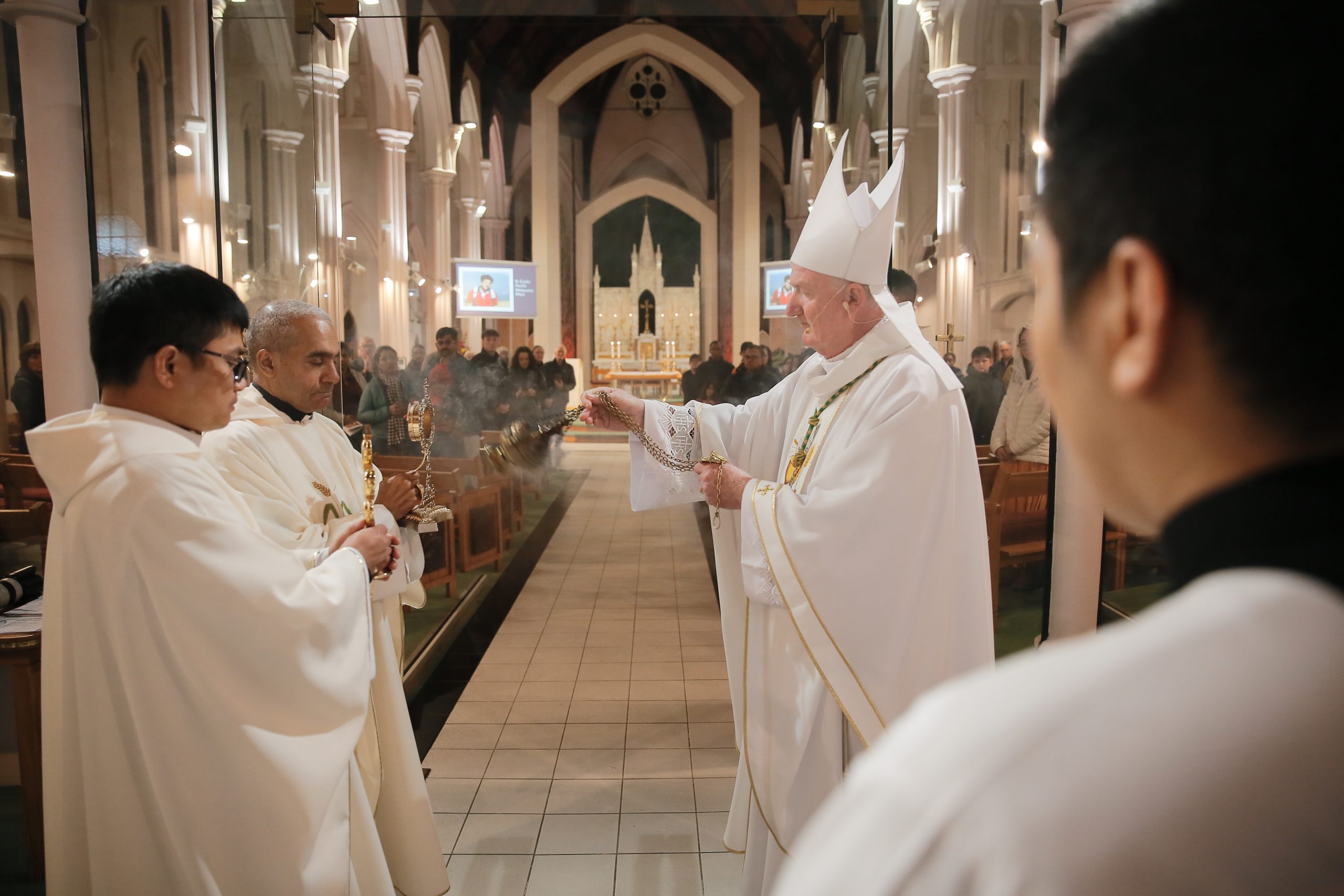
The recent visit of the relics of Saint Carlo Acutis also revealed something important about the life of faith in our diocese. Some have thought that the Second Vatican Council put an end to the devotional life of the Church, but I disagree. I resist any either/or mentality here. There is always both/and: robust intellectual and theological engagement with the truths of our faith, and, at the same time, a flourishing devotional life.
The response to Saint Carlo’s relics made that clear. We saw tremendous crowds, and there were moments that, in the deepest sense, were supernatural. At Hato Pāora College, Bishop Peter said beautifully that the boys would never forget the relics visiting their school, and Monsignor Anthony, who accompanied the relics, found it deeply evocative to bring Carlo Acutis into that school environment.
Here at the cathedral, people with no connection to the Church felt drawn into the building. Some had never been inside a church before, yet found themselves kneeling in veneration before the relics. Busloads came from Hawke’s Bay, and many of our schools had a beautiful, if too brief, time with them. There was a tremendous response and a great desire to pray with Saint Carlo.
He had a marked effect on the faithful of this diocese, and we’ve heard similar reports from Wellington, Hamilton, Christchurch and Dunedin. What is going on there? It is a very interesting question. But there is life in that space, and I am thankful we had the relics here.
We may also be the only diocese in New Zealand to have applied to the Bishop of Assisi and been granted a first-class relic of our own: strands of Saint Carlo’s hair. So Saint Carlo has left, but in a way he remains with us. We now need to obtain a reliquary and establish a place of honour for the relic in the cathedral. I am also keen that Saint Carlo will keep visiting, particularly the young people of this diocese. There is something very powerful in that.
Renewing our life of mission and service
Bishop
Published on 1st Sep, 2026
There are several signs of new life emerging across our diocese. Each is different, but together [..]
Renewing our life of mission and service
Bishop
Published on 1st Sep, 2026
There are several signs of new life emerging across our diocese. Each is different, but together [..]
Prayer, family, young people and priestly identity
Bishop
Published on 4th Aug, 2026
Over recent weeks, I have been reflecting on the life of our diocese [..]
Prayer, family, young people and priestly identity
Bishop
Published on 4th Aug, 2026
Over recent weeks, I have been reflecting on the life of our diocese [..]
Hopeful Signs for the Road Ahead
Bishop
Published on 30th Jun, 2026
Bishop John reflects on cathedral renewal, vocations growth, discernment, and Saint Carlo’s impact [..]